
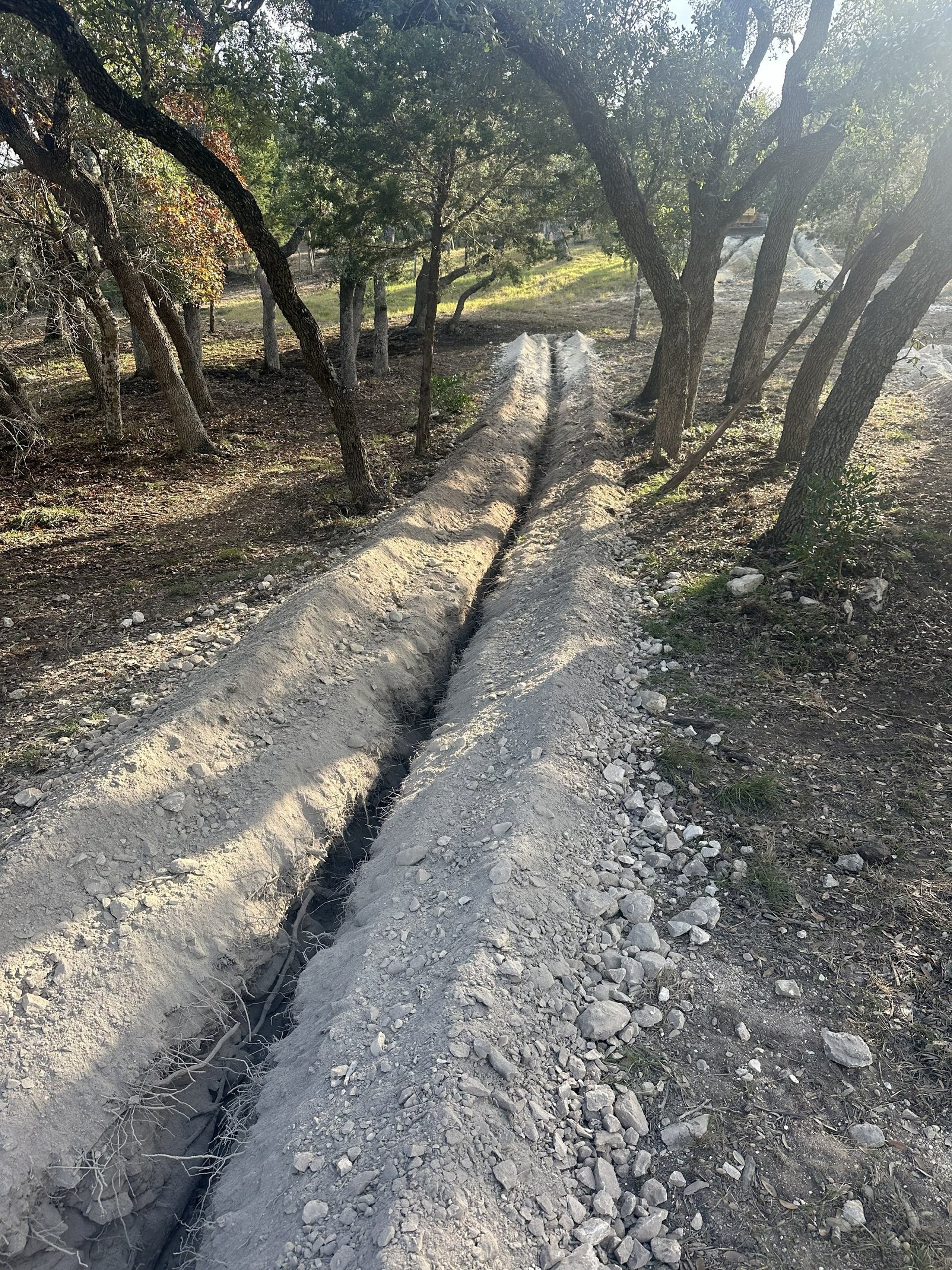
Oak Wilt Containment
Using Trenching to Help Control Oak Wilt in South Central Texas
How Trenching Helps Stop the Spread
Rock saw trenching creates a physical underground barrier that cuts through and separates the root systems between infected and healthy trees.
A trench is cut several feet deep into the soil and limestone using specialized rock saw equipment. By severing the roots that connect trees, the trench interrupts the path the fungus uses to spread.
Once the root systems are separated, healthy trees outside the trench line are far less likely to become infected.
Why Rock Saw Trenching Works Well in South Central Texas
South Central Texas soil is often shallow with dense limestone underneath. Traditional trenching equipment struggles in these conditions.
Rock saw trenchers are specifically designed to cut through hard limestone and rocky ground, allowing trenches to be installed where other excavation methods cannot operate effectively.
This makes rock saw trenching a practical solution for rural properties, ranches, subdivisions, and wooded acreage throughout the region.
When Trenching is Most Effective
Oak wilt trenching is most effective when:
The disease center is identified early
A trench is installed ahead of the advancing infection line
The trench reaches sufficient depth to sever root connections
The barrier fully surrounds or isolates infected trees
Professional evaluation is often recommended to determine the best trench location and layout.
Protecting Your Trees
Oak wilt can spread quickly, but early intervention can help protect healthy trees and limit the damage. Mechanical trenching provides a proven way to slow the disease by cutting off its underground pathway.
For property owners across South Central Texas, trenching offers a practical tool for protecting valuable live oak stands and maintaining the health of their land.
Oak Wilt Cost-Share Assistance
Texas A&M Forest Service (TAMFS) has administered a federal cost-share program, the Texas Oak Wilt Suppression Program (TOWSP), to assist landowners in their fight against oak wilt since 1988. The overall goal of the TOWSP is to minimize the spread of oak wilt (Bretziella fagacearum) in Central Texas.
Trenching to contain the spread of oak wilt, roughing inside the trench, or removal of certain diseased red oaks may qualify for limited cost-shares. Cost-shares for trenching are capped at 50% of approved costs up to $5,000 per cooperator per year and multiple cooperator project costs are capped at 50% of approved costs up to $7,500 per project per year. Cost-shares for roguing or pushing are capped at 50% of approved costs up to $5,000 per cooperator per year. Cost-shares for removal of certain diseased red oaks are capped at 50% of approved costs with a maximum of $2,000 per cooperator per year.
Kerrville Region – Includes Atascosa, Bandera, Bexar, Comal, Edwards, Gillespie, Karnes, Kendall, Kerr, Kimble, Kinney, Mason, Medina, Menard, Real, Uvalde, and Wilson counties.
Elizabeth Nyawo
Texas A&M Forest Service Staff Forester
P.O. Box 293127
Kerrville, TX 78029
(830) 792-8885
Elizabeth.Nyawo@tfs.tamu.edu
Protect your investment.
Trenching tough terrain with Texas precision.
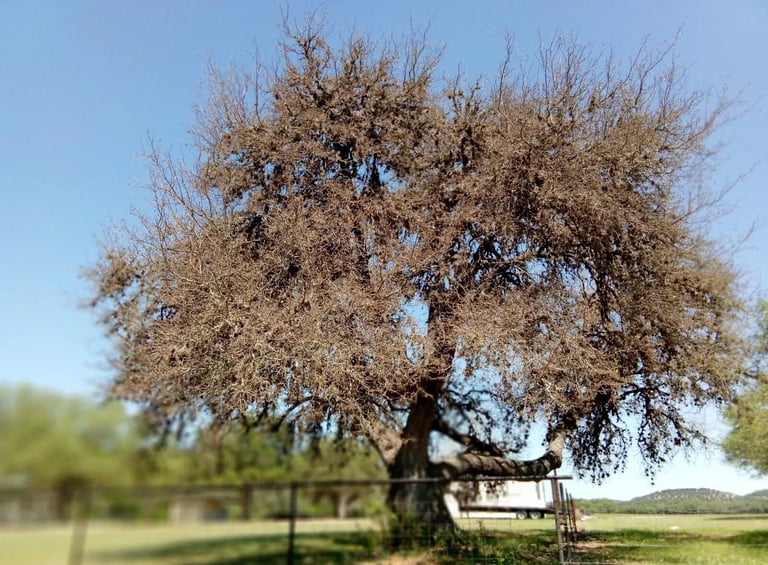
Oak wilt is one of the most destructive tree diseases in Central and South Central Texas. Once it enters a stand of oak trees, it can spread rapidly underground through interconnected root systems. Without intervention, the disease can move from tree to tree and destroy entire groups of live oaks.
One of the most effective methods to slow or stop the underground spread of oak wilt is mechanical trenching.
How Oak Wilt Spreads Underground
In areas with dense live oak populations, neighboring trees often share connected root systems. When one tree becomes infected with oak wilt, the fungus can travel through these roots and infect nearby trees.
This underground transmission is responsible for much of the rapid spread seen across Central Texas.
Primary office in Boerne, Texas. Serving Kendall and adjoining counties and within a 100 mile radius.
210-250-0887
info@rocksolidtrenching.com


© Pixelhaze 2024. A Hostinger Website Builder Template by Pixelhaze Studio